

Hair Transplant
Hair transplant in Turkey is a surgical hair restoration procedure that moves healthy hair follicles from a donor area to areas affected by hair loss. The treatment is commonly used for androgenetic alopecia and selected cases of permanent thinning. Planning should consider donor density, hair caliber, scalp condition, hair loss pattern, age, future progression, and the number of grafts required.

What Is a Hair Transplant?
A hair transplant is a surgical procedure that redistributes existing hair follicles to areas where hair density has decreased. The donor area is usually located at the back and sides of the scalp. Hair follicles from these regions often show greater resistance to androgen-related hair loss. The extracted grafts are implanted into thinning or bald areas according to a planned distribution. A transplant does not create new follicles. It relocates available donor hair, which makes donor management a central part of treatment planning.
Who May Be Suitable for Hair Transplantation?
Hair transplantation may be suitable for adults with permanent hair loss and a sufficiently stable donor area.
Common candidates include people with male or female pattern hair loss, selected scars, or localized areas of permanent thinning.
The existing donor supply must be strong enough to support the planned coverage.
Diffuse thinning, active scalp disease, unstable hair loss, or insufficient donor density can limit treatment options.
Age alone does not determine suitability. The likely progression of future hair loss should also be considered before creating a permanent hairline.
How Is Hair Transplantation Planned?
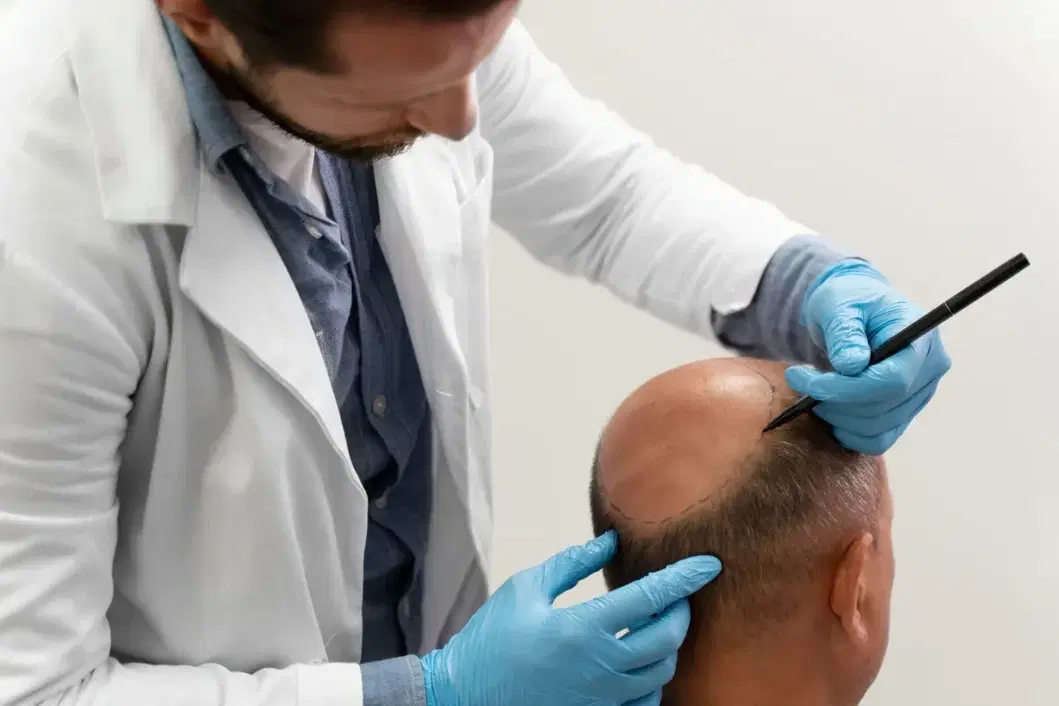
Hair transplant planning begins with assessment of the donor area, recipient area, scalp condition, and overall hair loss pattern.
Hair density, follicular grouping, shaft thickness, curl, color contrast, and scalp visibility can influence the visual result.
The hairline should be planned according to facial proportions and expected future hair loss. An excessively low hairline can consume valuable donor grafts.
The number of grafts required depends on the size of the treatment area and the intended density.
Donor preservation remains important because available follicles are limited.
What Is FUE Hair Transplantation?
FUE, or Follicular Unit Extraction, removes individual follicular units directly from the donor area using small punches.
Each graft can contain one or more hair follicles. After extraction, the grafts are prepared and later placed into the recipient area.
FUE avoids the linear donor scar associated with strip-based methods. However, it still creates many small extraction sites across the donor zone.
The extraction pattern must be carefully distributed to prevent visible donor thinning.
FUE describes the graft harvesting method rather than the entire hair transplant procedure.
What Is DHI Hair Transplantation?
DHI is commonly used to describe implantation with pen-shaped implanter devices after follicular units have been extracted.
The grafts are loaded into an implanter and inserted into the recipient area at planned angles and depths.
DHI does not represent a completely separate source of grafts. Follicles are still usually harvested individually from the donor area.
The technique may support controlled placement in selected cases, particularly where existing hair must be preserved.
Final density still depends on graft supply, recipient anatomy, and treatment planning.
Sapphire FUE and Conventional FUE
Sapphire FUE generally refers to recipient channels created with sapphire blades instead of conventional metal blades.
The extraction stage remains based on FUE principles. The difference mainly concerns the instrument used when preparing recipient sites.
Channel dimensions, direction, depth, spacing, and angle influence how grafts are positioned.
The material of the blade alone does not determine the final result.
Donor management, graft handling, hairline planning, and correct follicle placement remain more important than marketing terminology surrounding individual instruments.
What Are Hair Grafts?
A graft is a naturally occurring follicular unit containing one or more hair follicles.
Some grafts contain a single hair, while others contain two, three, or occasionally more hairs.
Single-hair grafts are often useful around the frontal hairline because they can create a softer transition.
Multi-hair grafts may contribute more visual density in areas behind the hairline.
Graft count and hair count are therefore not identical measurements.
A treatment plan should consider both the number and quality of available follicular units.
How Many Grafts Are Needed?
The number of grafts required depends on the size of the thinning area, existing hair density, donor capacity, and desired coverage.
A small frontal recession may require considerably fewer grafts than advanced hair loss affecting the frontal, mid-scalp, and crown regions.
Hair thickness and curl can also influence the appearance of density.
Maximum graft extraction should not automatically be the objective. Excessive harvesting can leave the donor area permanently thin.
A balanced plan distributes limited donor resources according to present and future hair loss.
How Is the Hairline Designed?
Hairline design considers facial proportions, age, existing hair, donor supply, and the expected progression of hair loss.
Natural hairlines are not perfectly straight or uniformly dense. Small variations in direction and distribution help create a less artificial appearance.
Single-hair grafts are commonly placed at the leading edge, while denser follicular units can be positioned behind them.
The hairline should also remain sustainable if native hair continues thinning.
A conservative design can help protect donor resources for possible future treatment.
What Happens on Hair Transplant Day?
The procedure usually begins with scalp preparation, hairline confirmation, and local anesthesia.
Follicular units are then harvested from the donor area according to the selected extraction method.
Extracted grafts are stored and organized before implantation. Recipient sites may be created before graft placement, depending on the technique.
The grafts are inserted according to planned direction, angle, and density.
Procedure duration depends on graft count, extraction speed, implantation method, and the size of the treatment area.
Is Hair Transplant Surgery Painful?
Hair transplantation is usually performed under local anesthesia, which reduces pain during extraction and implantation.
Patients may feel pressure, movement, or temporary discomfort during certain stages.
Mild tenderness can occur after the procedure, particularly in the donor area.
Temporary swelling may also develop around the forehead in some patients.
Pain levels vary between individuals, but persistent or increasing pain should be assessed because it may indicate an issue requiring clinical attention.
What Is Recovery Like After a Hair Transplant?
Recovery after a hair transplant commonly involves redness, small crusts, scalp sensitivity, and temporary swelling.
Tiny scabs form around implanted grafts and gradually separate as the scalp heals.
Patients usually receive instructions about washing, sleeping position, exercise, sun exposure, and avoiding trauma to the recipient area.
The donor area also requires time to heal after follicle extraction.
Visible postoperative signs generally improve during the early healing period, although scalp appearance can vary according to skin characteristics and graft count.
When Does Transplanted Hair Start Growing?
Transplanted hairs commonly enter a temporary shedding phase after the procedure.
This does not necessarily mean the follicles have been lost. The hair shafts may shed while the follicles remain beneath the skin.
New growth generally begins gradually after the resting phase.
Density develops over several months rather than appearing immediately.
Hair growth can continue to mature for a year or longer, especially in areas such as the crown.
The final result should therefore not be judged during early postoperative months.
Is Transplanted Hair Permanent?
Transplanted follicles are usually selected from donor areas that are more resistant to androgen-related miniaturization.
These follicles generally retain many of their original biological characteristics after transplantation.
However, surrounding native hair can continue thinning over time.
Natural aging can also influence hair caliber and overall density.
Hair transplantation should therefore be planned alongside the likely progression of future hair loss.
Some patients may require medical management or additional transplantation later, depending on their pattern of thinning.
Can Hair Transplantation Treat the Crown?
Hair transplantation can be used to restore selected crown areas when donor supply and hair loss pattern allow it.
The crown often requires a relatively high number of grafts because of its size and natural spiral growth pattern.
Dense crown restoration may compete with frontal areas for limited donor resources.
For this reason, treatment priorities should be carefully planned in patients with advanced hair loss.
The frontal hairline and mid-scalp may sometimes receive priority because they have a greater visual impact from normal viewing angles.
What Are the Risks of Hair Transplantation?
Hair transplantation carries potential risks including infection, bleeding, scarring, swelling, numbness, folliculitis, poor graft growth, and unnatural hair direction.
Excessive donor harvesting can create visible thinning or patchiness in the donor region.
Shock loss may temporarily affect existing hairs near treated areas.
Poor planning can also result in an unnatural hairline or uneven density.
Careful donor assessment, controlled extraction, proper graft storage, and anatomically appropriate implantation help reduce avoidable complications.
Hair Transplant in Turkey for International Patients
International patients considering a hair transplant in Turkey should understand the complete treatment plan before surgery.
The plan should explain the estimated graft requirement, donor limitations, hairline design, extraction technique, implantation method, and expected recovery.
Travel schedules should allow time for early postoperative assessment and appropriate scalp care.
Patients should also receive clear instructions for washing, medication, physical activity, and follow-up after returning home.
Hair transplant in Turkey can restore selected areas of permanent hair loss by redistributing existing donor follicles. Sustainable donor management, natural hairline planning, careful graft handling, and long-term consideration of future hair loss remain central to treatment quality.

You can send us messages regarding your appointments and requests.
 Send Message