

Breast Augmentation
Breast augmentation in Turkey is a cosmetic surgery that increases breast volume and improves breast shape using implants or fat transfer. The procedure may also address breast asymmetry, volume loss, or changes following pregnancy and weight fluctuations. Treatment planning considers chest anatomy, existing breast tissue, skin quality, implant dimensions, and the patient’s desired proportions.

What Is Breast Augmentation?
Breast augmentation, also called augmentation mammoplasty, is a surgical procedure designed to increase or restore breast volume. The operation most commonly uses silicone breast implants, although selected patients may consider fat transfer. The objective is not simply to increase breast size. Surgeons also evaluate breast width, projection, position, symmetry, nipple location, chest-wall dimensions, and soft-tissue coverage. A proportional result depends on matching implant characteristics with the patient’s anatomy. Choosing an implant based only on cup size can produce an unsuitable result because bra measurements vary considerably.
Why Do Patients Consider Breast Augmentation in Turkey?
Patients may consider breast augmentation because of naturally small breasts, breast asymmetry, volume loss, or changes after pregnancy. Significant weight loss can also reduce breast fullness and alter overall breast proportions.
Some women have developmental differences between the breasts or chest wall. In these cases, augmentation may form part of a broader surgical plan designed to improve symmetry.
Turkey also receives international patients seeking breast surgery because private hospitals and aesthetic surgery facilities offer treatment pathways for overseas visitors.
What Types of Breast Implants Are Used?
Breast implants differ in shape, profile, diameter, projection, surface characteristics, and internal filling material. Silicone gel implants are widely used in modern breast augmentation procedures.
Round implants generally provide volume throughout the breast, while anatomical implant designs aim to create a specific contour. Implant profile describes how far the implant projects forward relative to its base width.
Implant selection should reflect the patient’s chest dimensions and available tissue. A larger implant does not automatically create a better aesthetic result.
The thickness of natural breast tissue is particularly important because it affects implant coverage and visibility.
Where Are Breast Implants Positioned?
Breast implants can be positioned above or below different layers of chest tissue. Common approaches include subglandular, submuscular, and dual-plane placement.
Subglandular placement positions the implant beneath breast tissue but above the chest muscle. Submuscular placement provides additional tissue coverage by positioning the implant partly beneath the pectoral muscle.
Dual-plane breast augmentation combines elements of different implant positions. It allows the surgeon to adjust the relationship between breast tissue, muscle, and implant according to anatomy.
The selected implant pocket can affect breast contour, recovery, implant visibility, and movement.
How Is Breast Augmentation Surgery Performed?
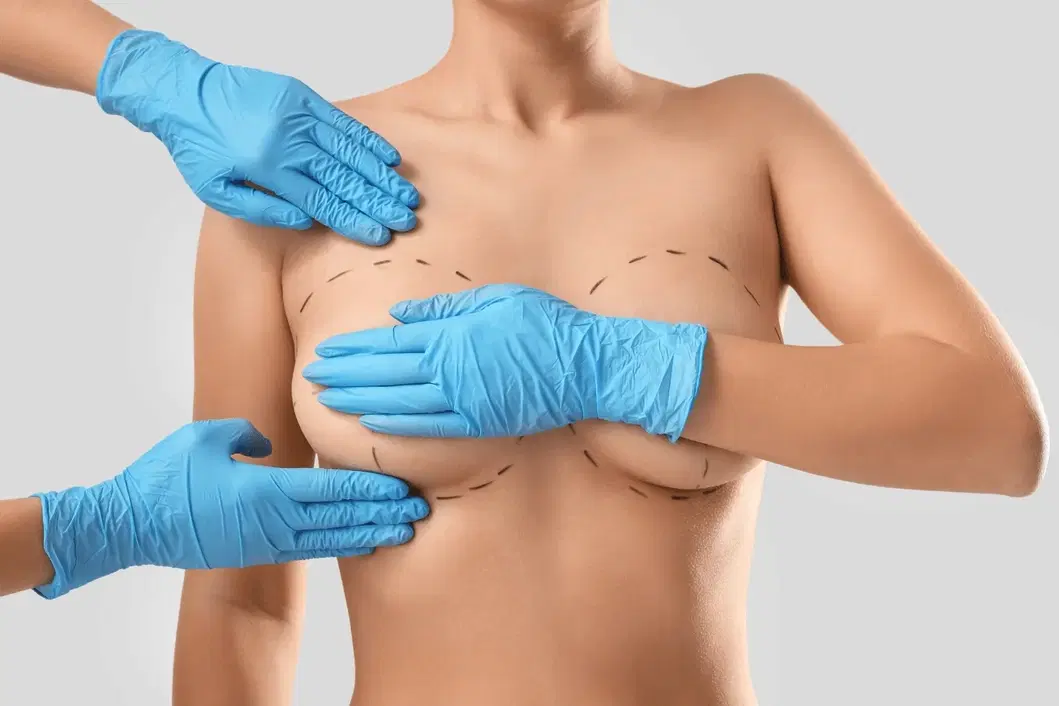
Breast augmentation surgery begins with preoperative markings and anesthesia. The surgeon then creates an incision and prepares the implant pocket according to the planned technique.
Incisions may be placed within the breast crease, around the areola, or in another suitable anatomical location. The inframammary incision beneath the breast is commonly used because it provides direct access to the implant pocket.
The implant is inserted after the pocket has been prepared. The surgeon assesses position, symmetry, and tissue tension before closing the incisions.
The exact surgical duration depends on the technique and whether another procedure is performed simultaneously.
Breast Augmentation and Breast Lift
Breast augmentation increases volume, but it does not always correct significant breast sagging. Patients with considerable skin laxity or downward nipple position may require a breast lift.
Breast lift surgery, also known as mastopexy, removes selected excess skin and reshapes the breast envelope. It can be performed alone or combined with implants.
Combining breast augmentation with a lift may address both volume loss and breast position. However, the procedure involves different incision patterns and surgical considerations compared with augmentation alone.
Correctly identifying whether volume, sagging, or both create the main concern is an important part of surgical planning.
Recovery After Breast Augmentation
Recovery after breast augmentation usually involves temporary swelling, tightness, tenderness, and changes in breast sensation. These symptoms generally become less noticeable as healing progresses.
A supportive surgical bra may be recommended during early recovery. Patients are commonly advised to limit heavy lifting and strenuous upper-body activity for a period after surgery.
Breasts can initially appear higher, firmer, or more swollen than expected. Their appearance changes as swelling decreases and tissues adapt around the implants.
Scar maturation continues for several months. Incision lines usually change gradually in texture and appearance during this period.
Are There Risks With Breast Augmentation?
Breast augmentation has potential risks like any surgical procedure. These may include infection, bleeding, scar problems, asymmetry, altered nipple sensation, implant displacement, or wound-healing complications.
Capsular contracture is another consideration. The body naturally forms scar tissue around a breast implant, but excessive tightening can affect breast firmness or implant position.
Implant rupture, rippling, rotation, or changes in breast tissue can also occur over time. Breast implants should therefore not be viewed as lifetime devices requiring no future monitoring.
Patients should understand both early surgical risks and longer-term implant considerations before treatment.
Can Breast Implants Affect Breastfeeding?
Many women can breastfeed after breast augmentation, but the ability to breastfeed cannot be guaranteed. Breastfeeding potential depends on existing anatomy, surgical technique, incision placement, and individual breast function.
Patients who may want children in the future should discuss pregnancy and breastfeeding considerations during treatment planning.
Pregnancy itself can change breast size, skin elasticity, and tissue position regardless of whether implants are present.
How Long Do Breast Implants Last?
Breast implants do not have a fixed replacement date that applies to every patient. However, they are not considered permanent lifetime devices.
Some patients may keep their implants for many years without requiring additional surgery. Others may need revision because of implant changes, tissue aging, personal preferences, or complications.
Breast appearance can also change naturally because of aging, pregnancy, hormonal changes, and weight fluctuations.
Long-term follow-up therefore remains an important part of breast implant care.
Breast Augmentation in Turkey for International Patients
International patients considering breast augmentation in Turkey should evaluate the complete treatment pathway rather than focusing only on surgery day. Preoperative assessment, hospital standards, postoperative monitoring, and follow-up planning all influence the patient experience.
Travel arrangements should allow enough time for initial recovery and postoperative examinations. Flying immediately after surgery may not be appropriate, particularly when swelling and mobility remain limited.
Patients should also understand implant specifications, surgical technique, incision location, expected recovery, and possible future monitoring before undergoing treatment.
Breast augmentation in Turkey can address breast volume, shape, and symmetry through an individually planned surgical approach. Detailed anatomical evaluation remains central to selecting implant dimensions, placement technique, and the most appropriate surgical strategy.

You can send us messages regarding your appointments and requests.
 Send Message